
Danielle Orrell
RESEARCHER
Danielle Orrell, Senior postdoctoral researcher
Country
Ireland
Institution
University College Cork
Ocean
Atlantic Ocean (Celtic Sea, Irish Sea)
Danielle Orrell is a senior postdoctoral researcher at University College Cork in Ireland. In this interview, we talk about their involvement with the Cetacean, Elasmobranch, Turtle and Seabird (CETUS) project, which uses tagging, tracking and passive acoustic monitoring equipment to understand the movements and habitat use of cetaceans, elasmobranchs, and seabirds in areas that overlap with offshore wind development.
Tell us about your research.
Irish waters are home to a rich diversity of animals, including elasmobranchs (sharks, skates and rays). Many elasmobranchs grow slowly, mature late, and produce only a small number of offspring, making them especially vulnerable to overexploitation. With several offshore renewable energy projects planned for Ireland, understanding the potential interactions between elasmobranchs and offshore wind infrastructure is essential. Yet movement data for elasmobranch species in the Celtic and Irish Seas remains limited, with most insights coming from observational sightings, mark-recapture tagging and ad-hoc reports.
As part of the broader CETUS project, this research addresses key knowledge gaps using acoustic and satellite tracking of elasmobranchs in proposed development areas, as well as in Ireland’s only operational offshore windfarm at the time of the study. Species tagged include flapper skate, tope shark, small spotted catshark, and porbeagle. The work will help reveal the spatial footprint of these animals and potential overlap with offshore wind development.
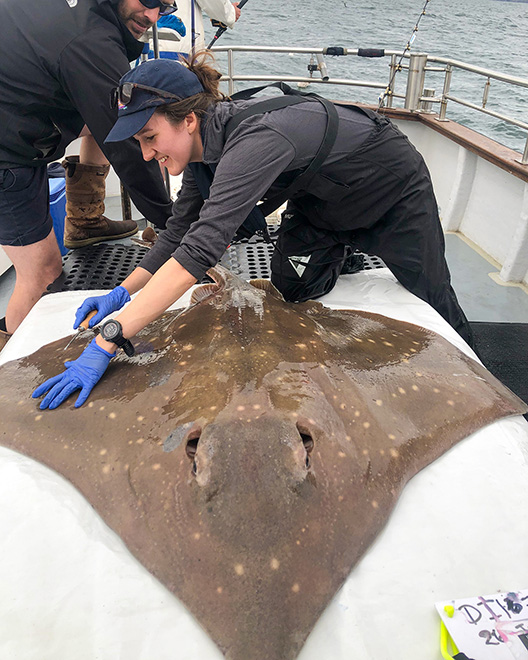
Danielle Orrell tagging a flapper skate.
Describe your research methods.
In partnership with Inland Fisheries Ireland, we have deployed arrays of acoustic receivers in the Celtic Sea and western Irish Sea. These arrays can detect tagged animals, providing important data on elasmobranch movements and habitat use in both coastal and offshore regions.
What is the most significant finding to date?
Several research papers from this project are undergoing peer review. It’s too early to share specific results, but we’re looking forward to being able to talk more about the findings as they become available.
How is the surrounding community involved in the project?
A key part of the project involves collaborating with local communities. On Ireland’s south coast, the acoustic array was co‑designed with a maritime advisory group that includes tourism operators and charter skippers. On the east coast, charter skippers continue to help researchers understand the local environment and assist with collecting animals for tagging.
How does OTN support your project?
The CETUS project was supported by an OTN equipment loan, which made it possible to expand the scope of the acoustic receiver array in the western Irish Sea. OTN’s virtual study halls and coding support community have also been a constant source of support throughout my postgraduate studies and into my current role as a researcher.
General inquiries
+1 902 494 4101
otn@dal.ca
Data Centre
otndc@dal.ca
Media Contact
anja.samardzic@dal.ca
Go to…
© 2026 Ocean Tracking Network