
MESSAGE FROM THE DIRECTORS
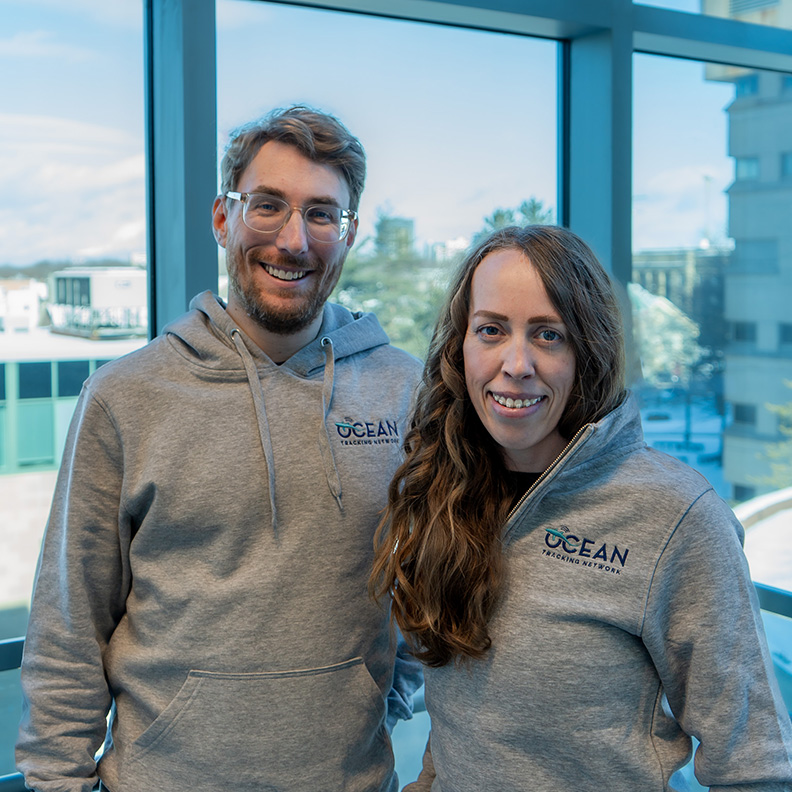 The past year marked a period of significant transition and momentum for the Ocean Tracking Network (OTN). With the retirement of OTN’s Executive Director, Fred Whoriskey, at the end of 2024, 2025 was the first full year under new leadership with Evelien VanderKloet moving into the position of Senior Program Director and leading the organization’s operations. We also appointed nine new members across OTN’s three advisory committees, bringing new expertise and perspectives to continue guiding our work.
A major focus of the year was our ongoing transition toward becoming a Canada Foundation for Innovation (CFI) Major Research Facility (MRF). In preparation for the MRF, we hosted an in-person network consultation in Halifax, alongside a highly successful early career researcher workshop, and convened our first in-person manufacturer’s forum with acoustic telemetry companies. These engagements helped inform the development of our MRF concept document, which was submitted to CFI in September 2025. We also closed the year with a very positive external review of OTN’s progress, impact, and vision by the CFI Standing Advisory Committee.
A federal election and a subsequent shift in national priorities have further underscored the importance of OTN’s work. The 2025 federal budget highlighted the need for digital tools to modernize fisheries management, and OTN is well positioned to support the Government of Canada’s efforts to strengthen evidence‑based monitoring, data integration, and decision‑making going forward. OTN’s technical expertise, infrastructure, and partnerships continue to play a role in supporting Canada’s strategic priorities, including Arctic sovereignty and national security, and in bolstering the Canadian economy by driving innovation in ocean observing and training a highly skilled workforce.
In addition to aligning with national priorities, we focused on growing our presence in the Arctic and Pacific. We were thrilled to engage in meaningful conversations on the role of national research facilities at forums across the country, including at ArcticNet’s 21st Annual Scientific Meeting and the 17th Canadian Science Policy Conference. OTN staff also attended the Pacific Salmon Ecology and Conservation Lab’s annual research symposium hosted by Dr. Scott Hinch at the University of British Columbia. As we continue to evolve OTN to meet the needs of the research community, we value opportunities like these to forge in-person connections across Canada’s three coasts.
Last year also saw significant new investment in ocean observation infrastructure. We were awarded a $700,000 grant from Fisheries and Oceans Canada (DFO) to deploy a new acoustic receiver array in the Fundian Channel–Browns Bank Area of Interest, expanding OTN’s coverage in the Atlantic region and supporting the management of an important Marine Protected Area network. In addition, DFO provided $1 million in support of 200 new acoustic receivers for our national loaner pool, strengthening tracking capacity for researchers across Canada. OTN also provided significant in-kind support to the Fundy Ocean Research Centre for Energy (FORCE) for its $8.2 million Natural Resources Canada–funded tidal energy initiative, strengthening partnerships across Canada’s renewable energy research landscape. Across the pond, our collaboration with European colleagues on the €8 million MOSAIC (PEACEPLUS-funded; Loughs Agency lead) was successfully funded, demonstrating the importance of cross-border partnerships in advancing conservation and science. MOSAIC, which will officially kick off this spring, will establish an interregional marine biological observation system to gather data on endangered and declining species and develop decision-making tools to inform management plans.
As we look forward, OTN is preparing for the next phase of the network. In the coming year, we’ll further refine our digital platforms and tools to facilitate the flow of data from science to policy, expand our presence in the Pacific and Arctic through both new and longstanding partnerships, and continue transitioning to the CFI MRF program and advancing national initiatives such as marine renewable energy and national security.
OTN’s achievements in 2025 reflect the dedication of our staff, the strength of our national and international partnerships, and the value of science networks in understanding and conserving changing ocean ecosystems. We extend our sincere thanks to all who contribute to OTN’s mission—our partners, funders, advisory committees, and the many researchers who use and support our shared national and global infrastructure. We’re excited for the future and the many bright opportunities that lie ahead.
Sincerely,
Robert Lennox, Scientific Director
Evelien VanderKloet, Senior Program Director