
The Oceans Technology (OTEC) Graduate Certificate Program at the Nova Scotia Community College is widely recognized as one of the province’s leading hands-on training programs in marine science and technology. Designed for those looking to deepen their expertise in ocean-related fields, the program offers a diverse curriculum that spans oceanography, telemetry, autonomous and remotely operated underwater vehicles (AUVs and ROVs), and fieldwork planning and logistics.
After completing a bachelor’s degree in marine biology, Jazmine Allan enrolled in the OTEC program and joined OTN’s telemetry operations team for a 6-month summer internship. We invited Jazmine to document her time at OTN, sharing her experience working in the field and her role in contributing to regional and global research initiatives.
My internship started in May, building on my telemetry knowledge and skills I gained in the OTEC program. I was familiar with some of the equipment OTN uses, but there was still a lot for me to learn to feel comfortable using each type. In the early weeks, I spent most of my time reading standard operating procedures and refurbishing receivers. This involved opening the pressure housing of receivers that had been recovered for data offloading, changing batteries and O-rings, and testing functions. These steps prepare the receivers for the next field mission or to be shipped to an OTN partner for their own research project. When field missions were approaching, I was tasked with helping the field team allocate equipment and prepare moorings.
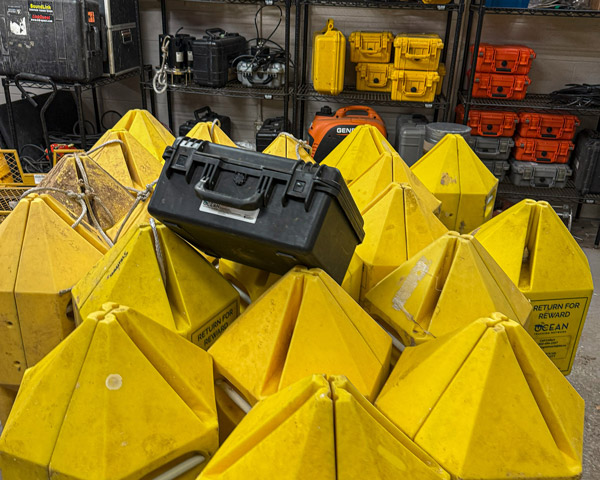
Kintama floats holding acoustic receivers equipped for a four-year deployment.
Entering the field
My first field work was the annual Bras d’Or Lake and Scaterie Island mission. Most field missions at OTN involve a “roll-over” of receivers in an array line, which are recovered and redeployed right after. This takes place over a few days and usually involves sleeping on the vessel—for this mission, we were on a lake, so we’d return to land each night to sleep. The receivers in the lake are widely spread across, which made for 8 days of vessel work. Before the mission, I prepared the necessary consumables including batteries, O-rings, and other refurbishment supplies, and as a team, we’d prepare the moorings and anchors for each station.
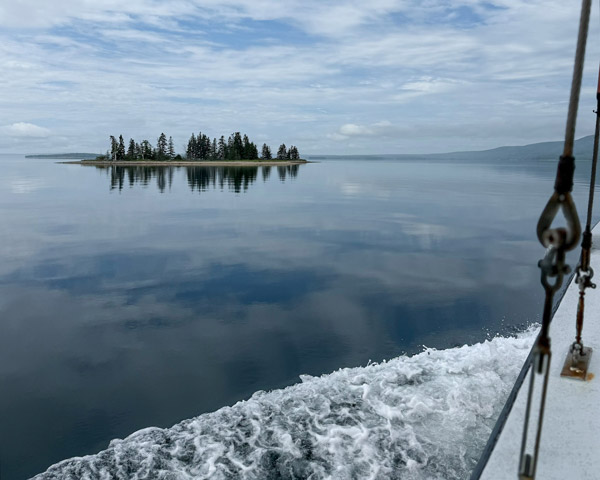
A picture of the glassy water of the Bras d’Or Lake in Cape Breton
The first day of the mission was for mobilization to the lake and a half-day on the vessel to start the equipment roll-overs. My main station was refurbishment. After a receiver was recovered, scraped free of biofouling (live organisms), and the data was offloaded, I’d change the battery and replace any faulty parts. I also helped rig the moorings by tying knots and was tasked with quickly going into the wheelhouse to enter waypoints as new moorings were deployed.
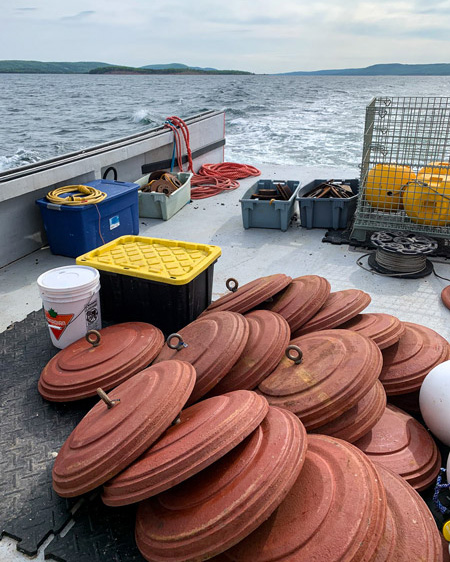
View of the vessel’s back deck filled with anchors and gear for deployments (Photo: Anne Mckee, CMAR).
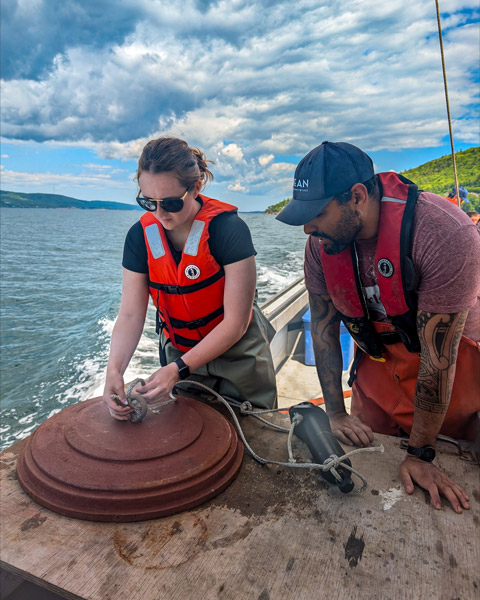
Iago helping me learn the knots used in OTN’s mooring design for the Bras d’Or Lake.
Throughout the mission, I saw biofouling in many forms, from stations completely covered in organisms, to some with none at all. The lake stations ranged from depths of less than 10m to over 100m. The shallow stations tended to have more biofouling; in this case, there were a lot of mussels.
For the remainder of the mission, I did a lot of refurbishments, but I also did my fair share of scraping biofouling. In the evenings, we had a few opportunities to fish for striped bass for a research project. Unfortunately, we didn’t catch anything, but we got to enjoy a beautiful sunset, many lightening bugs, and the beginning of a thunderstorm.
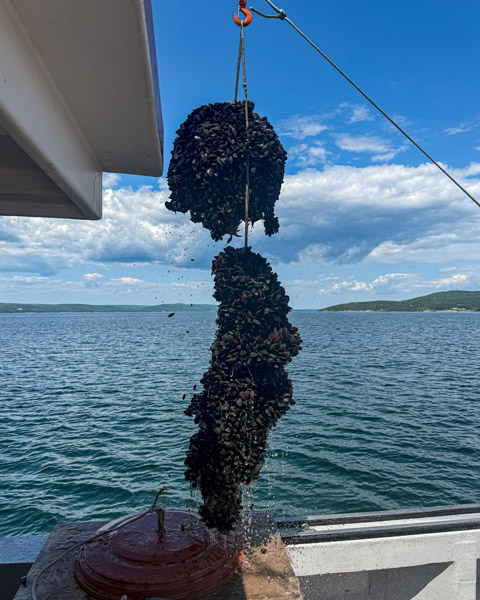
A recovered mooring including the float, rope, and acoustic receiver covered in mussel biofouling.
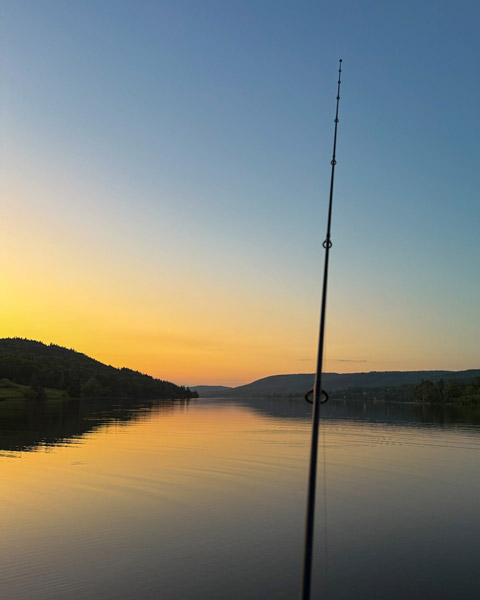
Fishing in a pond for striped bass while the sun sets.
After the mission, I was tasked with updating the project’s metadata. I uploaded it, along with a mission report and the receiver offloads, to OTN’s data portal. It was exciting for me to go through the entire process and understand how the data is integrated and managed at OTN.
Since the Bras D’or Lake mission, I’ve been part of shorter field missions, which have included overnights on a vessel. They’ve all involved similar tasks for preparation and operations but differed slightly depending on the equipment required. However, removing biofouling, offloading data and rolling-over receivers remained consistent.
Working with the tide
My final field mission for the summer was in the Bay of Fundy’s Minas Passage—home to the world’s most extreme tides. The preparation for this mission differed from the other missions because of the mooring design and receivers used. The equipment needs to be able to withstand strong currents, meaning the moorings require heavier anchors and hardware, and more floatation. Timing is very important for these missions because of the tide levels at the wharf. At low tide, the vessel sits on the seabed.
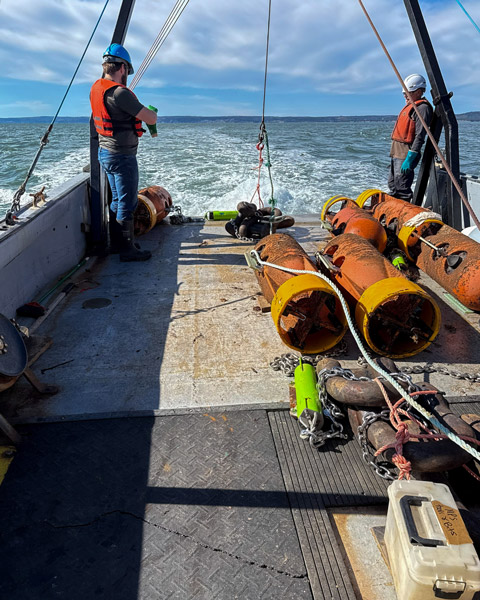
Unique mooring components for Minas Passage stations.
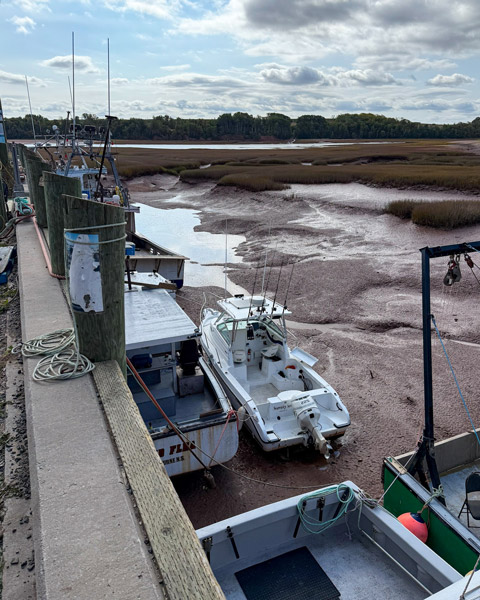
Vessels tied to the wharf resting on the seafloor at low tide.
Timing is also key because of the slack tide—the time when the currents aren’t moving too quickly in either direction. This is the best time to recover moorings, and it happens only for a short window of time. The limited ideal working time—paired with the vessel’s weight limitations—meant that 12 deployments and recoveries took 4 days.
We left the wharf as soon as there was enough water to do so, approaching the high tide, and tried to get to the first station during the slack tide for recoveries. We then steamed back against the outgoing tides, which is when the recovered moorings could be refurbished for the next deployments. The outgoing tides meant there wasn’t enough water at the wharf by the time we got back! We loaded into an inflatable boat, which took us from the vessel to a nearby beach, while the crew waited for the tides to change enough to dock the vessel several hours later.
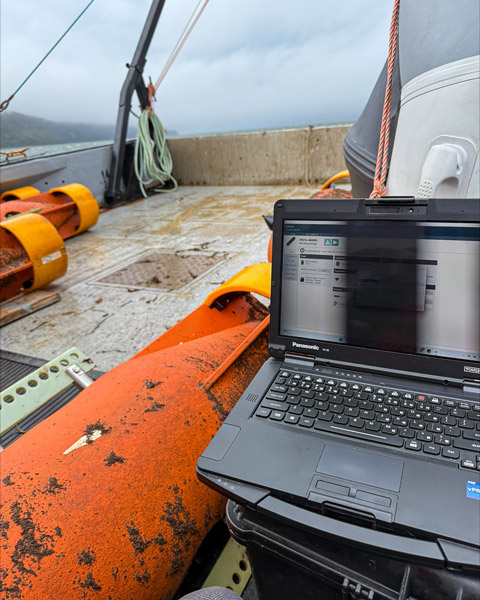
Offloading receivers on the way back to shore.
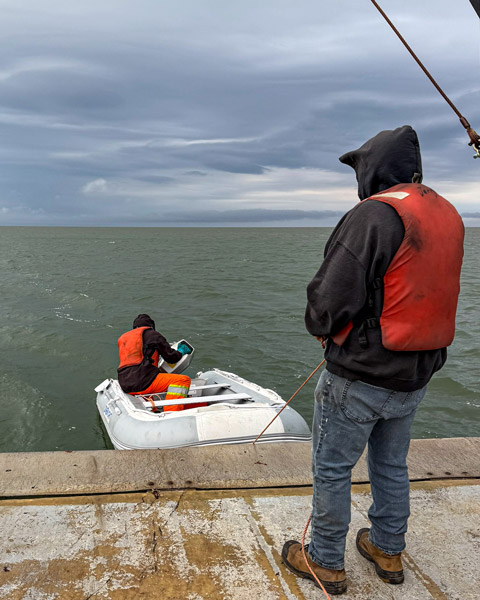
Inflatable boat off the vessel stern preparing to take us to a nearby beach.
Beyond the field
Aside from field missions and the associated preparations or demobilizations, I was able to learn from other teams at OTN too. I worked with remotely operated vehicles (ROVs) in the Dalhousie Aquatron with the ROV team mostly to improve my piloting skills in preparation for any ROV recoveries that may have been required over the summer. I was later tasked to troubleshoot an issue with a BlueROV, and used trial and error to test a few solutions but ultimately didn’t have enough time to completely diagnose and fix the issue. I left my notes about the progress with the ROV team to continue troubleshooting before the next field season. It was cool to get more exposure to the electrical components of ocean technology and spend some time problem solving.
I also spent some time at COVE with the glider team, learning how to prepare Teledyne Webb Research Slocum gliders and Liquid Robotics Wave Gliders for deployments, and was lucky enough to attend a few deployments at sea. I helped ballast a Slocum glider, making it the perfect weight to be neutrally buoyant in sea water. There are a lot of calculations involved to ensure a glider flies properly and doesn’t tip to one side.
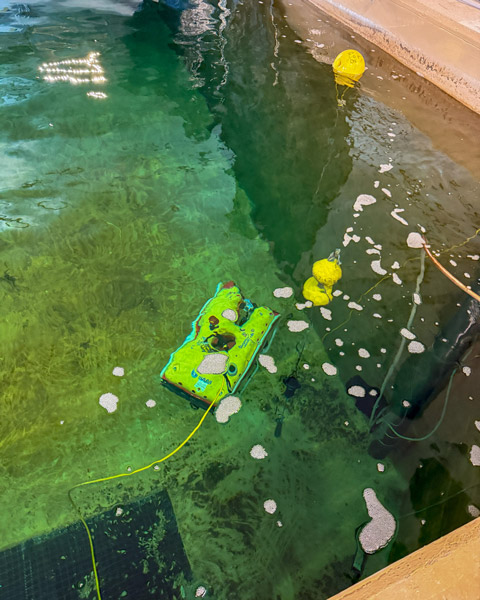
OTN’s Falcon ROV in Dalhousie’s Aquatron next to a mooring for recovery practice.
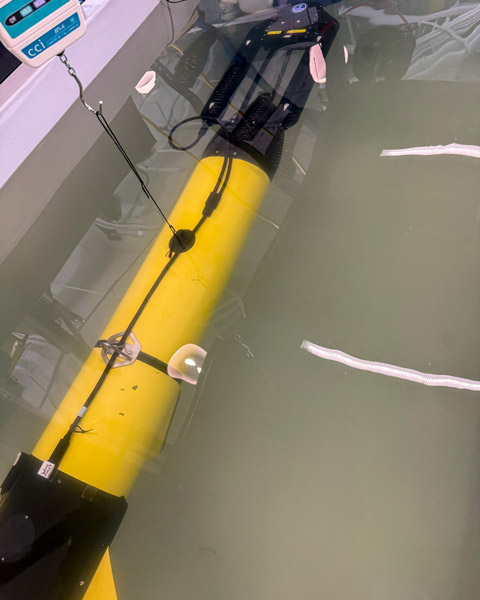
A Slocum glider in the ballast tank while the weight in water was measured.
I put my small vessel operator proficiency training to use when I learned how to pilot Wave Gliders to remotely offload acoustic receivers and also spent time learning about the internal components and what’s involved in preparing one for deployment. The exposure I’ve had working with gliders will prove useful as I transition roles from the telemetry operations team to the glider team this fall.
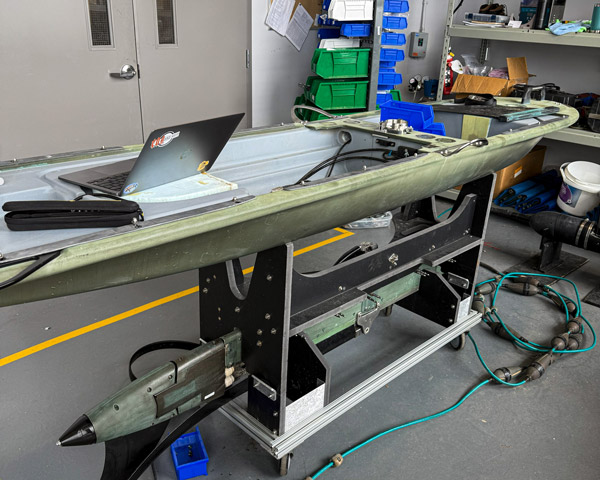
Early preparations of a Wave Glider to be sent offshore to offload data from receivers on the seafloor.
Lesson learned
I’m grateful to OTN for a summer full of new experiences. Everyone was supportive in a way that fostered my growth in the position and increased my understanding of underwater acoustics. The telemetry operations team especially guided me to be more independent and confident in my abilities. I was always encouraged to learn and take part in anything that interested me, ultimately leading me to my next opportunity with the glider team. I look forward to my new position as a glider technician at OTN and can’t wait to absorb as much knowledge as possible.